
This is the question we get most often during a splashback quote. Solid colour or printed. Both are glass, both look impressive on the showroom sample. The real question is which one looks better in five years, ten years, twenty years. The honest answer comes from looking at the difference in construction and where each one fails over time.
This post is for Penrith homeowners trying to make this decision before signing off on a kitchen.
The short answer
Solid coloured splashbacks last longer in a real kitchen and are cheaper to repair when something does go wrong. Printed splashbacks are more design-flexible but have more failure points. For a kitchen you plan to use heavily for ten years or more, solid colour is the safer call. For a feature wall or a stylised kitchen with specific imagery, printed can be excellent if you choose a quality manufacturer.
How each one is made
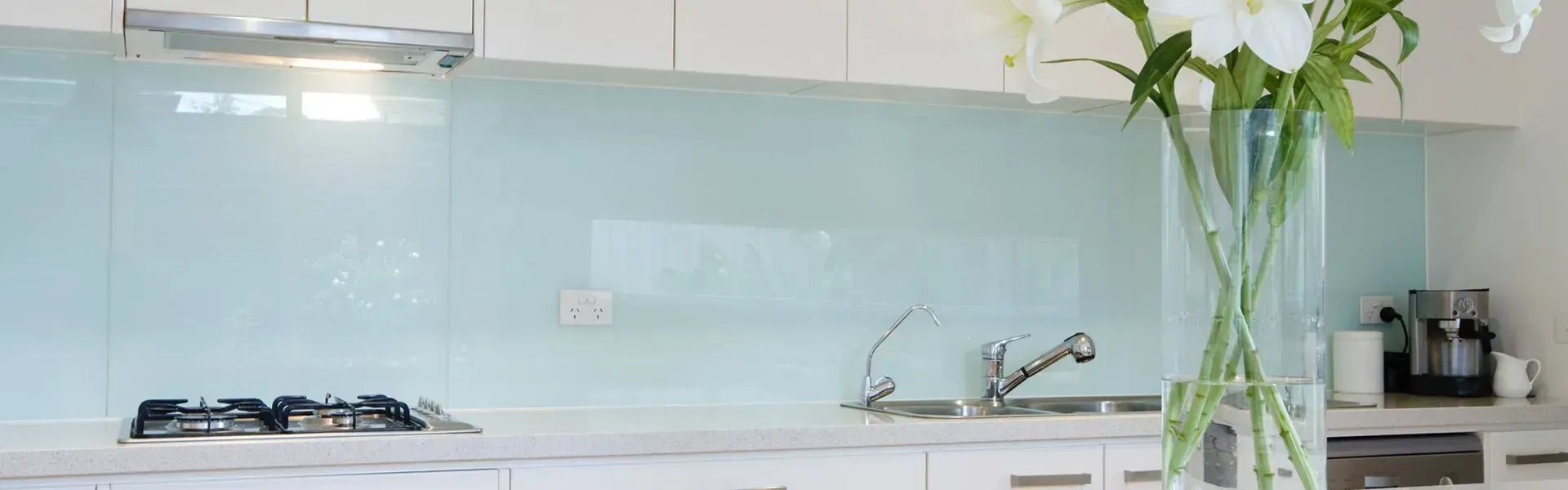
Solid coloured splashback: Toughened safety glass with two-pack polyurethane paint applied to the back of the glass, sprayed in a dust-free environment, with edge sealing. The colour you see from the front is the paint visible through the glass.
Printed splashback: Toughened safety glass with a digital image printed on the back, usually with UV-cured pigment-based inks, then sealed with a protective coating, often with a final colour layer for opacity.
Both are real glass. The difference is what is on the back.
Where each one fails over time
Coloured splashback common failures:
- Edge silvering or moisture damage if edge seal fails. Rare.
- Paint colour shift if exposed to extreme UV. Very rare in most kitchens.
- Glass crack or chip from impact. Replaceable.
Printed splashback common failures:
- Fading of the print under direct UV. Visible after 5 to 10 years in sunny kitchens.
- Edge lifting of the print or protective coating. Common in lower-quality prints.
- Banding or unevenness in the print as it ages. Rare in high-quality prints.
- Glass crack or chip. Same as coloured.
The key difference: a coloured splashback has a single uniform paint layer that ages slowly and uniformly. A printed splashback has multiple layers (image, protective coat, sometimes opacity coat), each of which can fail independently.
UV exposure: the most common longevity question
A kitchen with a south-facing window has minimal UV impact on either splashback. A kitchen with large east, north or west-facing windows has UV stress on the splashback for years.
- Solid colour with quality two-pack paint: 15 to 25 years of stable colour.
- Printed with UV-cured pigment inks: 8 to 15 years before noticeable fading.
- Cheap printed splashbacks: 3 to 7 years before visible degradation.
For a Glenmore Park home with a kitchen on the west side of the house, the UV question matters. Solid colour is the safer choice.
Repair and replacement comparison
If a coloured splashback gets damaged:
- Standard colours can be re-ordered from the same paint code.
- The replacement panel looks identical to the original.
- Lead time: 7 to 10 working days.
If a printed splashback gets damaged:
- The print file must still be available from the original supplier.
- Colour matching the print to the existing panel is harder than matching paint.
- Lead time: 10 to 20 working days.
- Cost: higher per square metre than coloured.
For homes that plan to be in the kitchen for many years, the easier replacement of coloured is a real advantage.
Cost comparison
Approximate Penrith-area pricing in 2026 for a 3-metre kitchen splashback:
- Standard coloured solid (6mm toughened, two-pack paint): $850 to $1,200.
- Low-iron coloured solid (premium colour accuracy): $1,100 to $1,500.
- Standard digital print on toughened glass: $1,400 to $1,900.
- Premium print with high-resolution imagery: $1,800 to $2,500.
- Custom photographic print: $2,200 to $3,500.
The cost premium of printed is 30 to 80 per cent over coloured for similar size and quality.
Design flexibility
This is where printed wins decisively.
- Photography or imagery. A printed splashback can carry literally any image: a landscape, a city skyline, a piece of artwork, a custom photograph.
- Pattern designs. Subway tile lookalikes, stone veining, abstract patterns.
- Multiple colours in one panel. Coloured glass is one colour. Printed can be many.
- Branding for commercial kitchens. Logos, designs, custom messaging.
If the design intent calls for any of these, coloured cannot deliver. Printed is the only option.
When we recommend coloured
For most family kitchens, especially:
- Long-term homes where the kitchen is heavily used.
- Modern neutral colour schemes.
- Budget-conscious choices.
- Kitchens with significant UV exposure.
- Homeowners who want easy future replacement.
A coloured splashback in a calm, mid-tone neutral covers 80 per cent of the kitchens we install in.
When we recommend printed
When the design calls for it:
- Feature kitchens with bold imagery.
- Commercial settings with branded glass.
- Heritage or themed kitchens where a specific image is part of the design.
- Smaller secondary splashbacks (behind a bar, in a butler’s pantry) where the design statement matters.
- Homeowners who want something distinctive and accept the trade-offs.
We do a fair amount of printed work for clients in Penrith and the surrounds. Done well, it is impressive. Done cheaply, it disappoints.
What to look for in a printed splashback supplier
If you decide on printed, do these checks before signing:
- Show me a 5-year-old print. Genuine UV stability is best demonstrated, not just claimed.
- What ink technology? UV-cured pigment is the current best. Dye-based inks fade faster.
- What protective coating? A clear topcoat over the print extends life.
- What opacity layer? Behind the image, a solid colour layer prevents the wall colour bleeding through.
- What is the warranty? Quality printed splashbacks come with 7 to 10 year warranties on the print specifically.
- Sample panel. Get a sample of the proposed print before ordering.
If the supplier hedges on any of these, walk away. The print should be guaranteed to last.
Common questions
Can I have a printed splashback look like a real backsplash tile? Yes. Print quality is high enough that printed tile-look splashbacks are convincing. Easier to clean than real tile.
Can the print be partial, like just a band of colour? Yes. Coloured background with a printed feature is a popular middle ground.
What about coloured glass with a frosted band? Possible. Frosted areas are sandblasted or acid-etched, not printed.
Can printed handle cooktop heat? Yes. The print is behind toughened safety glass. The glass handles cooktop heat. The print is protected from direct heat.
Maintenance
Both types of splashback need the same care:
- Mild detergent and microfibre cloth.
- No abrasives.
- No ammonia-based cleaners (can damage the back coating over time).
- Wipe up grease and food residue promptly.
- Inspect the silicone seals around the edges every 3 to 5 years.
A well-maintained splashback of either type lasts the life of the kitchen.
When to call us
Call us if:
- You are deciding between coloured and printed for a new kitchen.
- An existing splashback (either type) is showing damage or fading.
- You want a custom print and want to know what is achievable.
- You want a sample panel before committing.
Phone 02 4722 2787 or send a photo of the kitchen through our contact form. For the broader splashback service, see the service page.
FAQ
How long do printed splashbacks really last? Quality ones with proper UV-cured ink: 10 to 15 years before noticeable change. Cheap ones: 3 to 7 years.
Can a damaged area be fixed without replacing the whole panel? No. The print is behind toughened glass, which cannot be patch-repaired.
Can I print on low-iron glass for true colour? Yes. Worth doing for pale or accurate-colour prints.
Is there a difference between Australian-printed and imported? Often yes. Australian manufacturers tend to use better ink and stronger warranties. Verify the source before ordering.
The choice between coloured and printed is genuinely a personal one. The longevity argument favours coloured. The design argument favours printed. Both are valid for the right kitchen.

