
A good glass splashback looks the same in twenty years as it did the day we installed it. A bad one fades, lifts at the edges, or cracks the first time someone slams a casserole dish on the stove top. The difference is not luck. It is a series of small specification choices, most of which get made before the glass is even cut.
This is the conversation we have with Penrith homeowners who want a splashback that lasts. No upsell. Just the things that matter.
The short answer
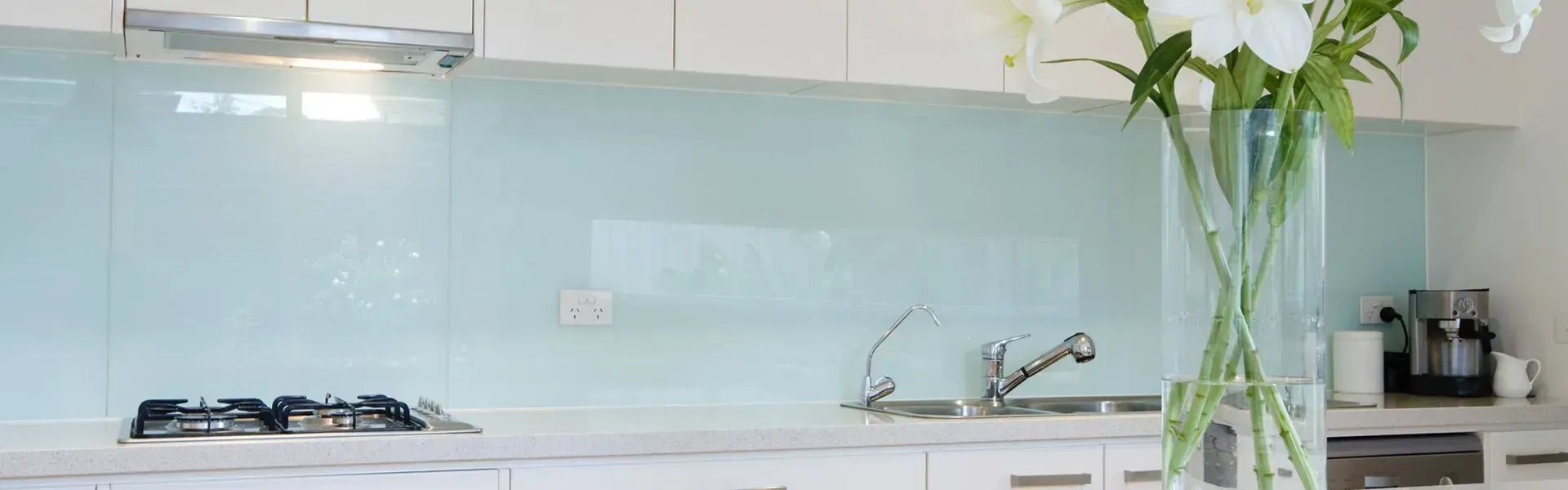
For a kitchen splashback that lasts, ask for 6mm toughened safety glass, low-iron if you want true colour, painted on the back with a quality two-pack polyurethane, and installed with the right adhesive on a sound substrate. Edges should be polished or smooth ground. Holes for power points should be cut before toughening. Skip the cheap MDF-and-vinyl alternatives. They look the same on day one and very different on day five hundred.
Start with the substrate, not the glass
The single biggest reason splashbacks fail in Penrith homes has nothing to do with the glass. It has to do with what is behind the glass.
If your wall is plasterboard with patchy plaster, fresh render that has not fully cured, or unpainted MDF, the splashback will fail. Not immediately. Eight to twelve months in, you will see small dots appear on the back of the glass. That is moisture coming through the substrate and reacting with the paint.
Before we measure for a splashback install, we want to see the wall. Smooth, dry, sealed and painted. If it is not, we tell the homeowner and the kitchen company. Better to delay the install a week than redo it in a year.
Glass thickness: 6mm is the right answer
Most kitchen splashbacks should be 6mm toughened glass. Some installers push 4mm to save money on smaller cuts. It looks fine, but it flexes, especially over uneven walls, and the flex shows in the paint over time.
For panels longer than 2.4 metres, or behind a gas cooktop, we sometimes use 8mm. Behind an induction or electric cooktop, 6mm is plenty. The Australian standard AS/NZS 2208 requires safety glass behind a cooktop, and toughened is the standard option.
Skip non-toughened glass for any splashback. Annealed glass behind a stove is asking for a crack the first time someone leaves a pot on too high.
Low-iron glass if colour matters
Standard float glass has a slight green tint when you look at it edge-on. You will not see it on a white wall, but you will absolutely see it on a pure white, pale grey, pale blue or yellow splashback. The colour comes out cooler and a little muddier than the swatch.
Low-iron glass (also sold as starphire or optiwhite depending on the supplier) costs about 25 to 40 per cent more but gives true colour. For a white kitchen, it is the difference between bright white and slightly mint. For a charcoal kitchen, you do not need it.
We will tell you on the quote which option suits the colour you have picked.
The paint on the back of the glass
This is the part most homeowners never ask about and most installers never explain.
The colour on a glass splashback comes from paint applied to the back of the glass. Quality of the paint, the application and the cure time decide whether the splashback looks the same in five years or peels around the edges by next summer.
Good practice:
- Two-pack polyurethane paint, sprayed in a dust-free booth, not brushed or rolled.
- A primer coat plus two or three top coats.
- Full cure before transport, usually 24 to 48 hours.
- Edge sealing to prevent moisture wicking in from the silicone joint.
Bad practice that we still see from cheaper suppliers:
- One coat of household paint applied with a roller.
- No primer.
- Glass shipped before the paint has cured.
- No edge sealing.
If you can find out who paints the glass and how, you have a much better chance of buying a splashback that lasts. We use a Sydney-based powder coater we have used for over fifteen years.
Edge work and cutouts
Every cutout for a power point, a hood vent or a tap has to be made before the glass is toughened. Once the glass is toughened, drilling or cutting it will shatter the entire panel. We have had homeowners ask us to “just add another hole” mid-install. The answer is always no.
This means accurate measurements matter. Take photos of the existing power point locations. Measure twice. Get the kitchen company to confirm the rangehood centreline and the cooktop position before we cut.
For edges, polished is the gold standard. Smooth ground is acceptable on edges that will be hidden behind cabinetry. Raw edges are not appropriate for any visible part of the splashback.
Installation tips that matter
The day of the install, a few details make or break the result.
- Adhesive: a low-modulus neutral cure silicone designed for glass-to-substrate. Not regular building silicone.
- Spacers around the perimeter to allow the panel to move with temperature changes.
- A clean silicone bead between the splashback and the bench top.
- No silicone visible on the face of the glass.
- Power point covers refitted with care so they sit flush.
If the installer is rushing, the silicone gets squeezed out the edges and you end up with a 3mm grey line along the bench. Not the end of the world, but not what most homeowners want for a brand new kitchen.
What about printed or digital splashbacks?
Printed splashbacks are real glass with an image printed on the back. Done well, they look fantastic. Done poorly, the print fades, gets blotchy under direct sunlight from a Glenmore Park kitchen window, or wears unevenly behind a cooktop.
The questions to ask:
- What is the print resolution?
- What is the UV rating of the inks?
- Is there a clear coat over the print before the back paint?
- Is there a warranty on the print specifically, or only the glass?
We cover the printed vs solid colour question in the splashback colour and finish post later in the series. For most homeowners, solid colour is the safer choice and is what we install eight times out of ten.
Don’t forget the warranty
A reputable splashback installation should come with a written warranty on the glass, the paint and the install. Standard expectations:
- Glass: 10 years against defects.
- Paint: 7 to 10 years against peeling, lifting and major colour change.
- Installation: 2 years against silicone failure and adhesion issues.
Ask for it in writing. If the installer hedges, that is your answer.
When to call us
You want to talk to us if any of these apply:
- New kitchen and you want a splashback that does not need replacing in five years.
- Existing splashback has lifted, faded or cracked and you want it replaced.
- You are partway through a kitchen install and the original installer has gone quiet.
- You have a strange shaped splashback and other suppliers said no.
We do splashback installs and repairs across Penrith and Western Sydney. We will measure, talk you through the colour, and quote the job in writing.
Call 02 4722 2787 or send a photo of the kitchen through our quote form.
FAQ
Can I get a splashback installed before the cooktop and rangehood go in? Yes, and that is often the cleanest order. We can install before final benchtop sealing too if the kitchen company has measured accurately.
How long does a glass splashback take to install? For a single panel up to about 3 metres, allow half a day. Multiple panels around an L-shaped or U-shaped bench, a full day. Cure time on the silicone is 24 hours before heavy use.
Are glass splashbacks heat resistant? Toughened glass handles cooktop heat without issue. We still leave a small gap and use heat-rated silicone behind a gas cooktop for peace of mind.
Can I match a Dulux colour? Yes. We can colour-match almost any Dulux, Resene or Taubmans swatch. Bring the colour code or a sample to the quote.
A good splashback is one of the cheapest ways to lift a kitchen. Spec it right once and you never think about it again.
